


For decades, when people discuss English learning, they almost always revolve around two modes: classroom and apps. Classrooms emphasize teacher instruction and standardized materials, while apps focus on fragmented practice and check-in incentives. They represent "traditional education" and "digital learning" respectively. But whether sitting passively in classrooms or staring at phone screens memorizing words, most learners face the same dilemma: the more knowledge they acquire, the less they can speak when they actually need to.
A user who had been learning continuously for years once said helplessly: "I check in on English learning apps every day, but when it comes to company meetings, I still can't speak at all." This feedback reveals the industry truth: classrooms and apps each provide content and tools, but neither has touched the core problem of language learning.
The End of Traditional Methods: Limitations of Classrooms and Apps
In classrooms, teachers' task is to impart the same knowledge to dozens of students. Unified materials, unified pace, unified exam standards. This system was extremely efficient in the exam era, but naturally ignores differences: fast learners feel bored, slow learners struggle to keep up; students who need speaking practice are forced to do more written grammar exercises, while those who urgently need interview preparation are still repeating "beach vacation" dialogues. Classroom knowledge is correct but often disconnected from students' real needs.
Apps seem to break time and space limitations, bringing freedom and convenience. Memorizing ten words daily, completing five-minute listening exercises, doing fill-in-the-blank tests—learners gain a sense of achievement from "persistence." However, most English learning app content still stays at the knowledge transmission level. It can teach you to "know" but hardly helps you "do." When you close the app and enter real contexts, almost everyone experiences the same gap: stammering, hesitation, translation, speechlessness.
The common limitation of classrooms and apps is: they assume sufficient knowledge input will naturally transform into language ability. But language is essentially not knowledge, but reflexive skills. You can learn verb tenses in books but struggle to use correct expressions immediately when questioned; you can memorize words perfectly but still can't speak complete sentences at airport counters.
The Real Problem Isn't Knowledge, But Environment
What learners truly lack has never been vocabulary, but environment. Classrooms and apps are more like heated swimming pools: comfortable temperature, clear water, but no waves, currents, or changing shorelines. You can swim several laps skillfully in the pool, but when you head to the ocean, you'll be caught off guard by sudden waves.
Language is the same. Without task-driven scenarios, situational changes, and social feedback, learners can never transform knowledge into reflexes. So they repeatedly return to the "comfort zone" of memorizing words and doing exercises, trying to compensate for output helplessness with more input. Over time, they fall into the cycle of "learning more but speaking less."
The real problem is not "insufficient effort," but lack of an environment where language can grow naturally.
New Direction: Immersive Virtual Worlds
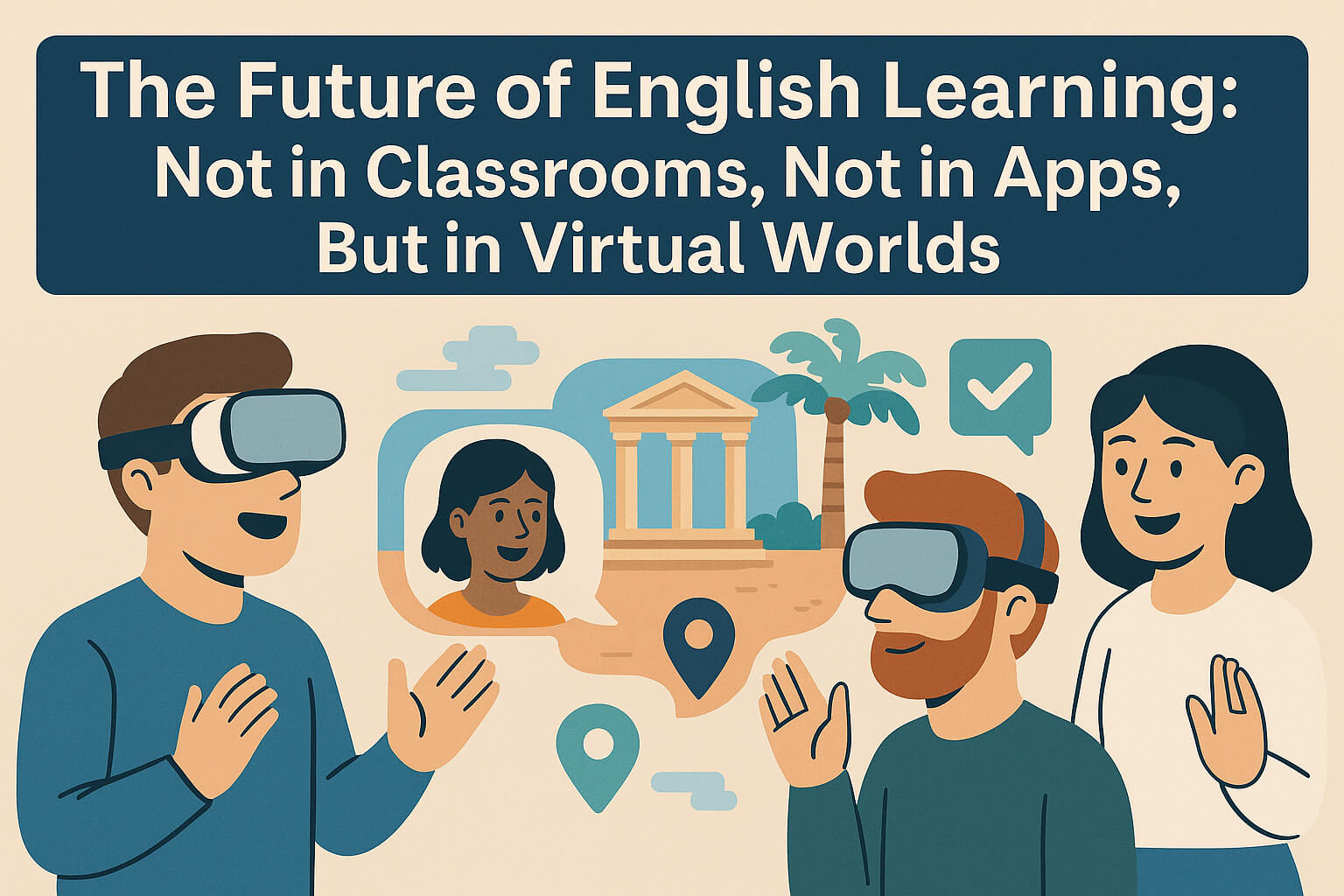
TalkiT's solution is to transform learning from "course consumption" to "environmental living." In immersive virtual worlds, users are no longer "students" but "residents."
-
In virtual cafes, you order a latte and chat with servers
-
In virtual offices, you discuss project progress with colleagues and express different opinions
-
At virtual parties, you chat with strangers, from hobbies to work, from weather to travel
These scenarios are not mere "teaching tasks" but interactions with goals and social meaning. The key is they are both "real" and "safe." No red X interruptions, no risk of embarrassment, no labeling due to silence. For the first time, learners discover that language can actually grow naturally in low-risk states.
This experience far exceeds "watching course videos" or "completing exercises." It allows learners to truly enter a "second language living space" rather than being limited to textbooks and question banks.
Method Innovation: Course → Avatar → Human
TalkiT designed a learning path completely different from traditional models:
-
Course: Curriculum as scaffolding, helping learners understand expression goals and build basic knowledge reserves
-
Avatar: Virtual humans as rehearsal partners, playing colleagues, servers, interviewers, accompanying you in repeated dialogues with high error tolerance, encouraging attempts
-
Human: Finally, learning returns to human communication, transferring proficiency to real life
The core logic of this path is: practice first, then perform. After completing sufficient low-risk practice in virtual worlds, reactions gradually become natural. When you enter real scenarios, your brain no longer needs translation but responds directly.
Users' Transformational Experiences
In TalkiT's beta testing, many users reported amazing transformations. Someone expressed complete opinions in simulated meetings for the first time and couldn't help laughing afterward, realizing they had never been so fluent in reality. Someone answered dozens of questions consecutively in virtual interviews—despite some mistakes, the entire process never interrupted. Someone practiced ordering hundreds of times in virtual travel scenarios and found themselves speaking naturally when actually going abroad.
This contrasting experience made users realize: past problems weren't that they "didn't learn enough," but that they never had an environment to turn knowledge into habits.
The Future of English Learning: Language as Life
Future English learning will no longer be limited to classrooms and apps, but enter a sustainable immersive environment. Language acquisition will no longer depend on homework and question banks, but come from natural interactions. Virtual worlds are not replacements but supplements: they solve the personalization that classrooms cannot provide and compensate for the realism that apps lack.
When you have a "safe but real" second language living space in virtual worlds, language logic will be completely rewritten:
-
From "knowledge learning" to "reflex training"
-
From "student role" to "living role"
-
From "learning without using" to "using without needing to learn"
The future of English learning lies not in classrooms or apps, but in virtual worlds.